Understanding the Role of Domain Extensions in Valuation: A Complete Guide
Complete guide to domain extension impact on valuation covering .com dominance, ccTLDs, new gTLDs, and future investment trends.
Editor
Domain Investment Expert
Understanding the Role of Domain Extensions in Valuation: A Complete Guide
When you're buying or selling a domain, the extension after the dot really can make or break its value. Domain extensions directly impact a domain's worth—.com domains almost always fetch the highest prices thanks to universal recognition and trust, while newer extensions are all over the map depending on industry and how much the market likes them.
The difference between a .com and a .xyz on the same name? That could mean thousands of dollars. Your extension choice affects not just the sale price, but also how buyers judge the domain's credibility and potential.
If you get a handle on how domain extensions influence valuation, you'll make smarter investments and skip some costly mistakes. Whether you're snagging your first domain or building a whole portfolio, knowing which extensions actually hold value is a real edge in the marketplace.
Key Takeaways
- Traditional extensions like .com usually deliver higher values than most newer options.
- Country-specific and industry-focused extensions can be valuable when they match the target market.
- Extension choice affects both immediate resale potential and long-term digital asset performance.
Why Domain Extensions Matter in Valuation
Domain extensions shape how much your domain is worth—and how fast it sells. The extension impacts buyer trust, market appeal, and the price you can realistically ask for your name.
Impact of Domain Extension on Perceived Value
Your domain extension shapes how people see your domain's value. .com domains are generally the most sought after because they carry instant credibility.
When buyers spot a .com, they often assume it's higher quality. That gut feeling translates to bigger offers and quicker sales.
Overview of Domain Extensions and Their Types
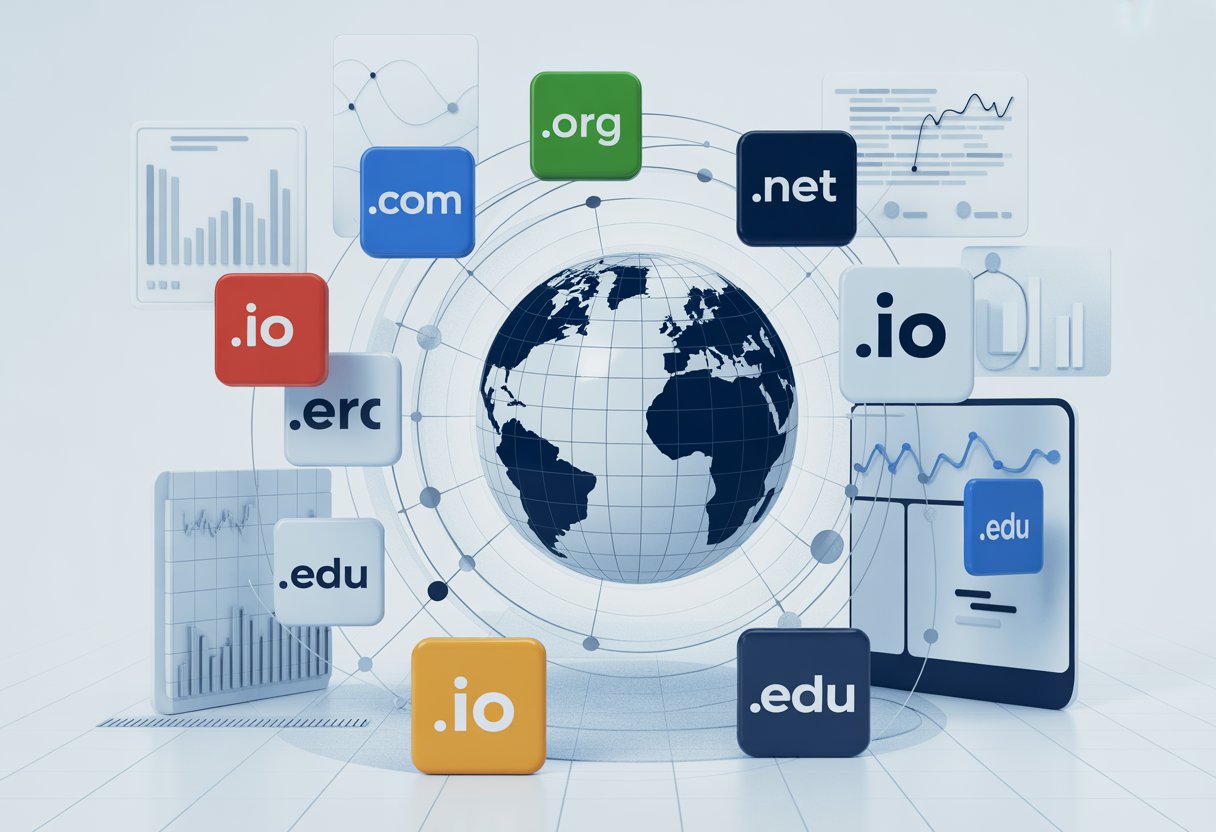
Domain extensions land in distinct categories, each serving different purposes and markets. You've got your traditional generics like .com, country-specific extensions, newer specialized options, and industry-focused alternatives.
Generic Top-Level Domains (gTLDs) and Their Position
Generic top-level domains form the backbone of the internet's naming system. These were among the first extensions ever created and are still the most widely recognized.
.com dominates the market—it's the most valuable and trusted extension. People just default to .com when typing web addresses. This extension works for any type of business or personal site.
.net started out for network providers but now acts as a solid .com backup. Lots of businesses go with .net if their .com is already taken.
.org was meant for organizations and non-profits. It's got trust signals for charities and community groups, but plenty of commercial sites use it too.
.com and Other Established TLDs: The Gold Standard
The .com extension commands premium prices because everyone recognizes and trusts it. .net and .org follow as backup options, each with its own quirks and price points.
.com Dominance in Domain Value
.com launched back in 1985 and quickly took over as the internet's main namespace. That head start gave .com domains a huge edge.
Expect .com domains to sell for 2-10 times more than the same name with a different extension. Most people just add ".com" when they guess a web address.
.com's dominance is wild—users see it as the most credible and trustworthy. Big companies almost always use .com for their main sites.
Assessing the Value of Country Code TLDs (ccTLDs)
Country code TLDs give you regional targeting and local trust. These domains can fetch high prices in strong digital economies, but market competition varies a lot by location.
Localized Branding and Trust with ccTLDs
Country code TLDs help sites look local and build instant credibility with regional audiences. Your ccTLD tells users and search engines you're relevant to a specific place.
Local consumers trust businesses using their country's domain. A .ca domain, for example, tells Canadians you get their market.
New gTLDs and Industry-Specific Extensions
The arrival of new gTLDs has opened up new territory for domain investors. Industry-specific extensions like .tech, .ai, and .io can fetch high prices because they fit tech brands perfectly.
Branding Opportunities with New Extensions
New gTLDs give you branding options that old-school extensions just can't. Pick something like .tech for your tech company and, boom, your domain instantly shouts what you do.
A .guru extension? That tells people you're the expert. Meanwhile, .store makes it obvious you sell things online.
Pricing and Market Perception
People's opinions drive the prices of new gTLD domains. The .io extension is pricey because tech startups love it, so demand is sky-high.
.ai domains have exploded in value thanks to the AI craze. Some sell for thousands—sometimes rivaling .coms in the tech world.
How Domain Extensions Influence SEO and Online Presence
Domain extensions play a big role in how search engines view your site and how users judge your credibility. Different extensions impact SEO through trust, location targeting, and how search algorithms treat them.
Extensions and Search Engine Optimization
Your domain extension tells search engines what your site is about. If your extension matches what users expect, search engines notice.
.com domains still have the edge—they're recognized and trusted everywhere. Authoritative domains get a boost over new or obscure ones.
Key Factors Affecting Extension-Based Valuation
A few key things determine how much your extension boosts your domain's value. Brand potential, keyword fit, and the domain itself all play a part.
Brand Recognition and Brandability
Your extension shapes how memorable and trustworthy your brand feels. .com is still the gold standard—people default to it without thinking.
Brand Trust Levels by Extension:
- .com - Top trust, everyone knows it
- .org - Great for nonprofits and communities
- .net - Solid for tech
- New extensions - Trust depends on how relevant they are
Trends, Digital Assets, and the Future of Extension Value
Domains are turning into real digital assets, not just web addresses. Market demand and tech changes are shifting how investors look at extension value.
Changing Market Demand and Investor Behavior
Investors are finally moving past .com obsession as newer extensions gain traction. Now, industry-specific extensions like .tech, .ai, and .crypto get real attention.
Frequently Asked Questions
Understanding domain extensions can feel overwhelming, but these common questions help clarify their role in valuation and investment decisions.
What factors influence the valuation of different domain extensions?
Market demand is the main driver. .com names sell for more because people want them.
Scarcity matters, too. As .coms get snapped up, prices climb, and new extensions get a shot.
Industry fit changes what buyers will pay. Tech companies might pay a premium for .tech, not so much for .info.
Age and reputation of the extension also play a part. Extensions impact value through how widely they're accepted and recognized.
Can the choice of domain extension affect search engine optimization (SEO) and, if so, how?
Search engines say they treat all domain extensions the same. Google doesn't really give .com domains a built-in advantage over the newer ones.
But your domain extension can nudge SEO in subtle ways, mostly through how people interact with your site. Folks tend to click on .coms more often simply because they trust them, and that can boost your rankings over time.
Brand recognition comes into play too. If your domain sticks in people's minds and matches what you do, you'll likely see more direct traffic and searches for your brand.
Geographic extensions like .uk or .ca? Those can give your local SEO a lift. Search engines often show these domains higher for location-based searches in their home regions.
How does the popularity of a domain extension affect its market value?
Popular extensions usually fetch higher prices. More people want them, so it's a bit of a scramble for the good names.
The .com extension is still king—everyone recognizes it, and that keeps its value up.
If big companies start using a certain extension, its reputation grows. That adoption makes it more credible, and people start to see it as trustworthy.
Extensions people remember and trust easily become more valuable. Familiarity really does matter in this space.
Are there any legal considerations when choosing a domain extension for brand protection?
Trademark protection isn't the same everywhere. You'll need to dig into the legal nitty-gritty for each extension you want to register.
Some extensions come with hoops to jump through. Government or organization domains might ask for proof you qualify, and they often have strict rules about who can use them.
It's smart to register key extensions for your brand. That way, competitors can't swoop in and grab a similar name—keeps your brand safer online.
International extensions can get tricky. Each country has its own rules, so if you're expanding globally, you'll want to check local laws before buying a bunch of country-specific domains.
What role does a domain extension play in the global accessibility and reach of a website?
Your domain extension shapes what users expect about your website's geographic focus. For example, country-specific extensions like .fr or .jp tell visitors your content or services cater to a particular region.
On the other hand, global extensions like .com feel more universal. They don't tie your site to any one country, so people might assume you're open for business anywhere.
Language and cultural cues also play a part here. Folks in different regions sometimes develop strong preferences for certain extensions, usually based on what they're used to seeing.
If you're wondering about technical stuff, you can relax—properly configured websites work the same no matter the extension. The choice of extension doesn't actually block anyone from visiting your site.